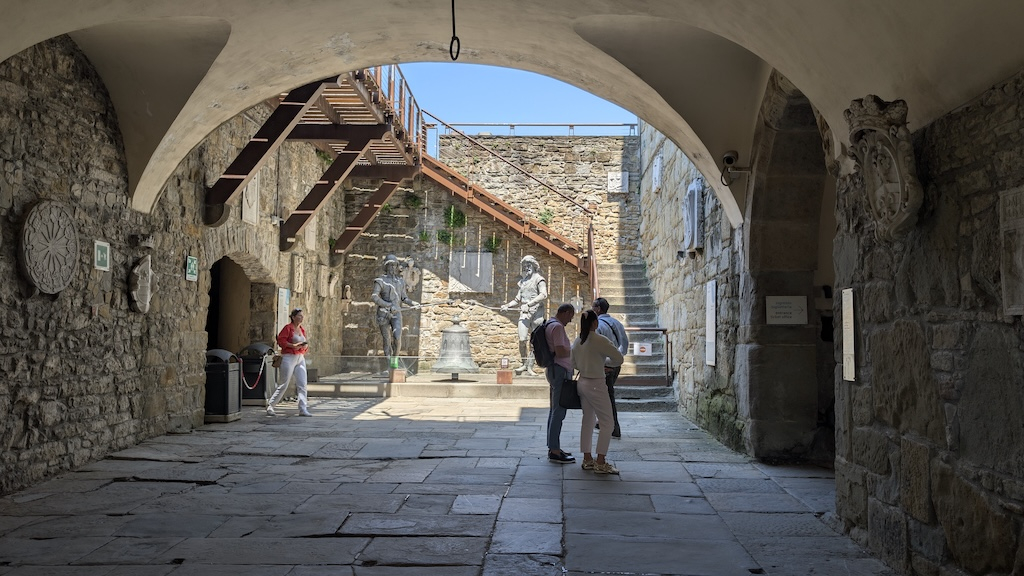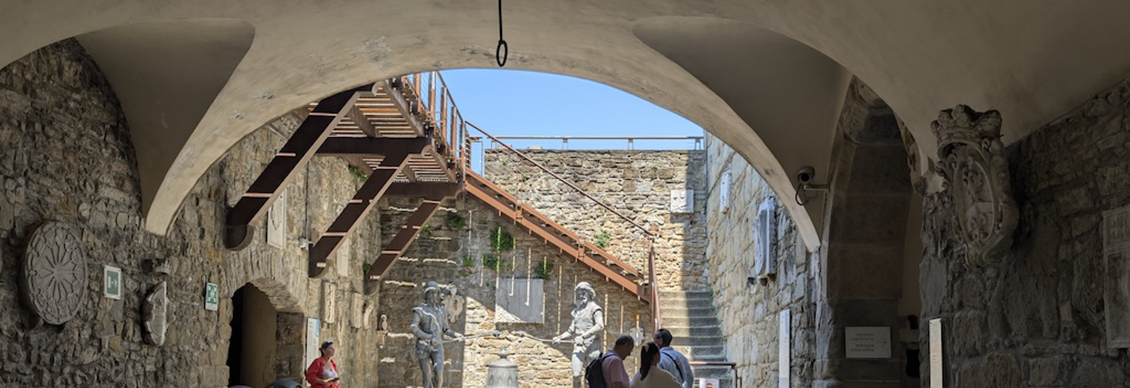
The Castello di San Giusto is a historic hilltop fortress overlooking the city and gulf of Trieste, Italy, constructed primarily between 1468 and 1636. Before the current castle existed, the strategic San Giusto hill served as the defensive and civic heart of the region for millennia. During the prehistoric Bronze and Iron Ages, a fortified settlement known as a castelliere occupied the summit. In the Roman era, this high ground became the acropolis of ancient Tergeste, housing major civic structures such as the forum and basilica. Throughout the Middle Ages, the hill remained the seat of local power, featuring a 13th-century fortified residence for the bishop-counts and an early fortress built by the Republic of Venice that was later demolished in 1381 by the Patriarch of Aquileia.
The construction of the modern fortress began in 1468 under the orders of Emperor Frederick III of Habsburg, following Trieste's voluntary submission to Austrian protection in 1382 to escape Venetian dominance. Built at the expense of the local citizens, the initial phase consisted of the Captain's House (Casa del Capitano), a fortified two-story residence flanked by a square, L-shaped tower designed to house the Imperial Captain who governed the city. This structure was intended not only to defend Trieste from external enemies, particularly Venice, but also to assert Habsburg authority over the local population.
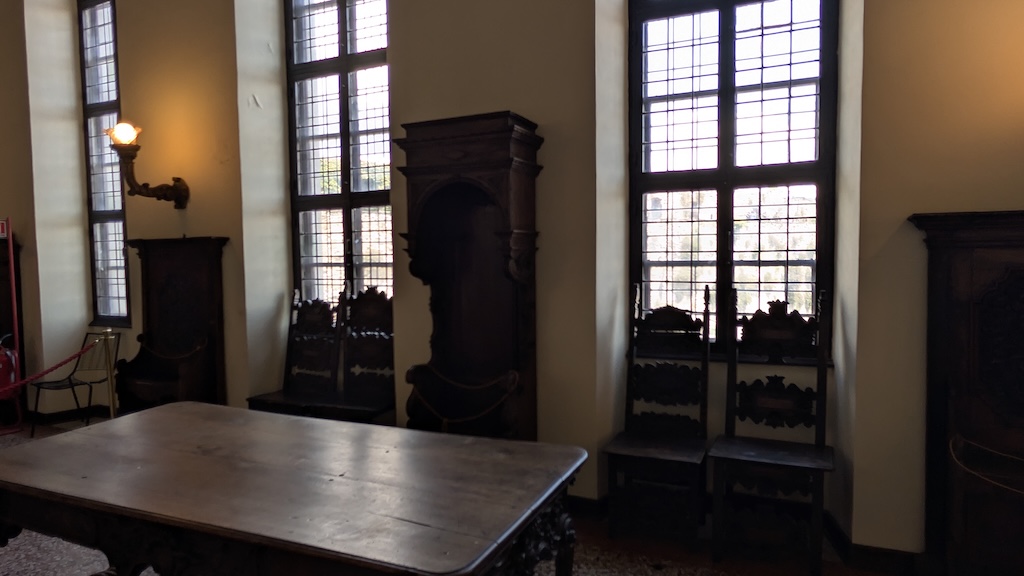
Having just left the church and seeing that something else of interest was so close, we walked over to see what it was all about. We weren't disappointed. We paid a small fee to enter and began to walk about. The high, thick walls were impressive, but so too was the view from the top. As one might imagine with a fort, it had a commanding view of everything around it.
Over the next century and a half, the fortress evolved into a massive triangular stronghold as competing powers adapted its defenses to modern artillery. During a brief Venetian occupation of Trieste in 1508 and 1509, the Venetians constructed the Round Bastion (Bastione Rotondo) at the northern corner. After the Habsburgs reclaimed the city, they continued expanding the triangular perimeter walls to match evolving military engineering. They added the polygonal Lalio Bastion in 1557 and finally completed the fortress in 1636 with the triangular Fiorito Bastion.
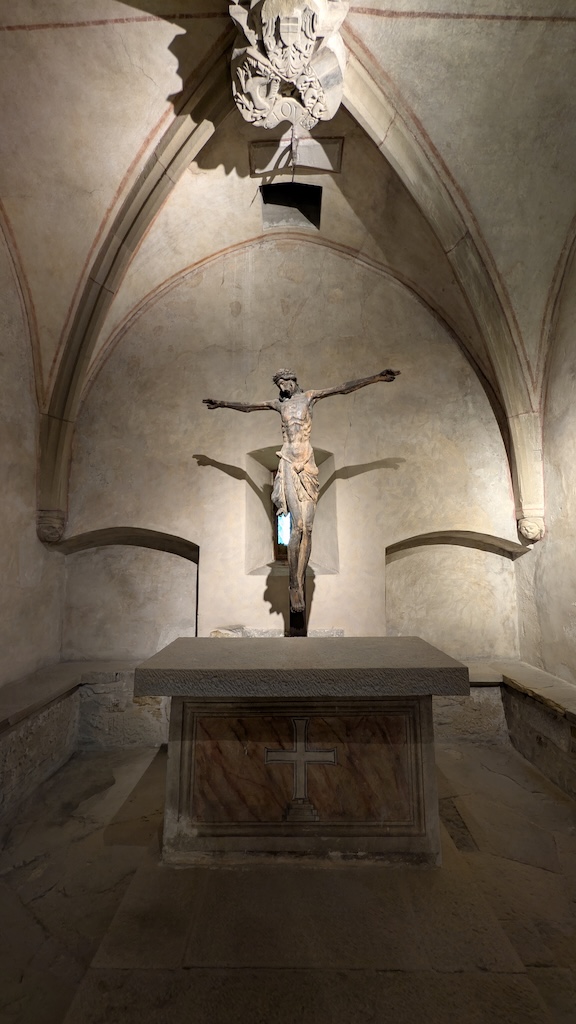
Despite its imposing walls and strategic vantage point, the Castello di San Giusto saw very little active warfare. Austrian Imperial Captains resided there until 1750, after which the complex was repurposed as a military garrison and a prison. Its rare moments of military action occurred in 1813, when French Napoleonic troops held out inside for two weeks against an Anglo-Austrian siege, and in 1945, when German forces surrendered the fortress to Allied liberation troops at the end of World War II.
In the 1930s, Italian authorities recognized the cultural and touristic value of the monument and undertook extensive restoration work to give the castle its present-day appearance. Today, the Castello di San Giusto operates as a prominent civic museum and cultural venue. Visitors can walk along its historic ramparts for panoramic views of Trieste and the Adriatic Sea, while the interior houses the Castle Museum with extensive collections of antique weaponry, armor, and Roman artifacts.
There's also a little cafe, if you're feeling like a drink with a stunning view of the harbour. We didn't stay around that long as we really wanted to see what we could before having to return to our ship.
360 Video: