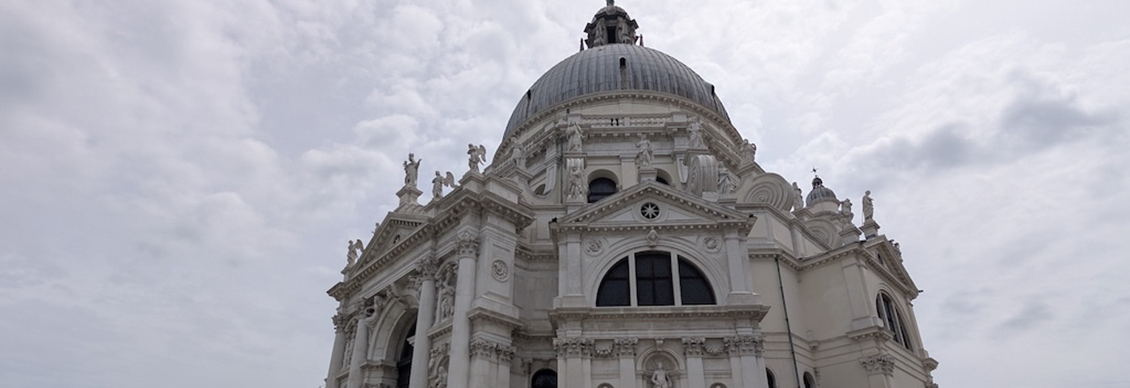
In our first night out exploring the surrounding area from our apartment, we enountered this marvel. So impressive by daylight, it was incomprehensible by night. We were so pleased to discover that it was open for us to look around inside. The interior, like most Italian churches, was almost overwhelming in it artistic beauty, to say nothing of the amazing architecture.
Basilica di Santa Maria della Salute, often simply called “La Salute,” is one of the great landmarks of Venice, standing at the entrance to the Grand Canal where it opens into the San Marco Basin. Its history begins with one of Venice’s darkest moments: the terrible plague of 1630. According to the basilica’s official history, the church was commissioned by the Serenissima, the Republic of Venice, as both a prayer and an act of thanksgiving to the Virgin Mary for the city’s preservation during the plague of the seventeenth century. Britannica likewise describes it as a votive church, built by the republic in thanksgiving for deliverance from the plague of 1630.
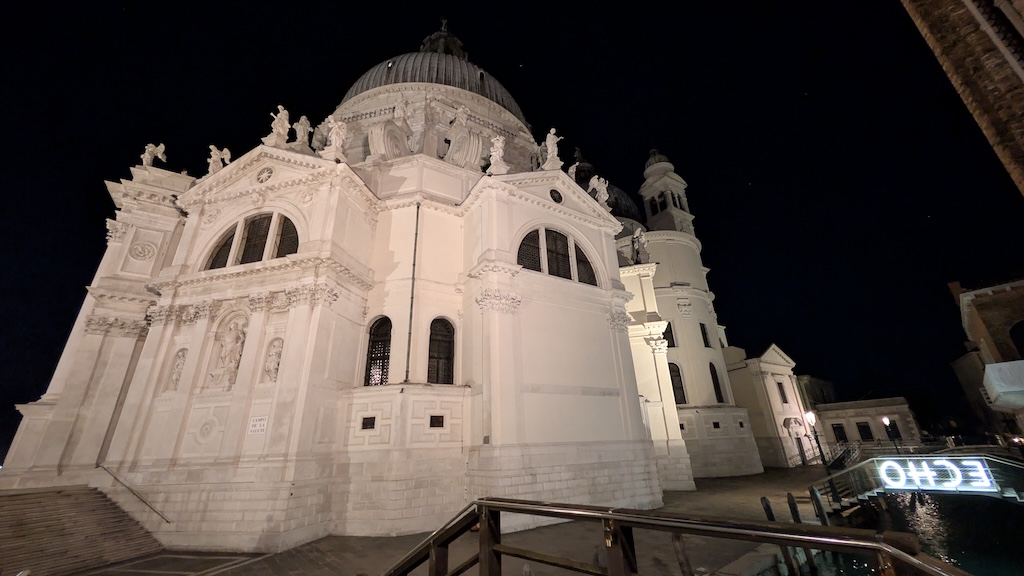
The first stone was laid on 1 April 1631, and the building was solemnly consecrated on 9 November 1687 by Patriarch Alvise Sagredo, though Mass had already begun to be celebrated inside before that date. The project was designed by Baldassare Longhena, one of the major Venetian architects of the seventeenth century. Britannica calls Santa Maria della Salute Longhena’s masterpiece and dates the work to 1631/32–1687, noting that it was placed at the entrance to the Grand Canal and commissioned in thanksgiving for deliverance from the plague.
We walked around the interior in a counter-clockwise direction, taking in everything we could. The details, like so many other churches in this country, beggared any attempt to fully absorb and comprehend. This was yet another incredible reason that Venice was among our favorite places to visit on this trip.
Architecturally, the basilica was designed to make a powerful impression from the water. The official basilica site notes that it faces the mouth of the Grand Canal and is approached by a broad staircase that seems almost to rise from the water. Its most famous feature is its double dome: the larger dome was conceived with the Crown of the Rosary in mind, while the smaller dome serves as the true sanctuary. Britannica highlights Longhena’s distinctive octagonal design, the great dome, and the sculptural figures set on spirals that act as buttresses.
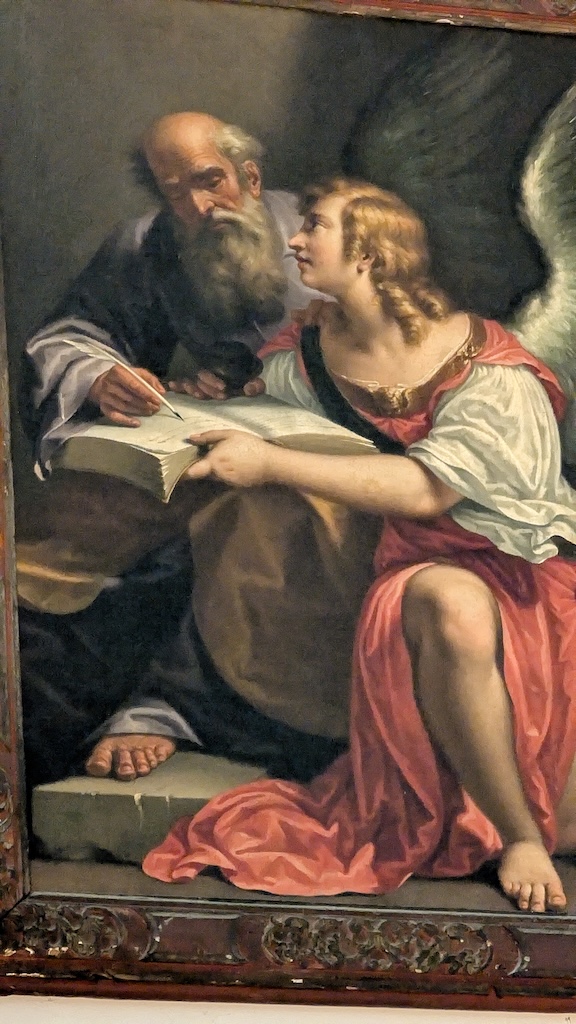
Inside, the basilica continues the same mixture of devotion, civic memory, and artistic drama. The official site describes a vast, bright interior with a central domed space, six side chapels, and a smaller sanctuary containing the venerated image of the Madonna della Salute, the Mesopanditissa, placed there in November 1670 after being brought from Candia. The high altar’s sculptural group shows the Virgin with the Child, an angel driving away the plague, and a richly adorned female figure representing Venice kneeling in supplication. In this way, Santa Maria della Salute remains not only a church but a lasting monument to Venice’s survival, faith, and gratitude after catastrophe.